

Added Sugar, Artificial Sweeteners, and Sugar Alcohols for Baby


Some of the links below are affiliate links. At no additional cost to you, I will earn a commission if you click through and make a purchase.
Added Sugars
Added sugars are sugars and syrups that are added into foods and beverages during preparation or processing. Added sugars are different from naturally occurring sugars, which can be found in fruit, starchy veggies, grains and milk.
What do we know about added sugars in infancy:
During the first years of life, the sweetness of sugars has a capacity to hinder or to help in laying a strong nutritional foundation for food preferences that often extend over a lifetime.
Research points to excessive sugar consumption associated with increased risk of dental caries, obesity, cardiovascular disease, type 2 diabetes, metabolic syndrome, and nonalcoholic fatty liver disease.
Consuming added sugars in the first two years of life replaces energy from nutrient-dense foods which increases the risk of nutrient inadequacies which may impact growth and development.
After this period, flexibility matters. Research shows that overly restricting any food, can create a hyper-fixation on that food. A whole-foods-based diet with small amounts of added sugar isn’t harmful and can even make nutrient-dense foods more appealing. For example, a drizzle of honey or maple syrup on sweet potatoes or carrots can encourage kids to eat more nutritious foods without consequence.
What are the current recommendations for added sugar?
The American Heart Association, American Academy of Pediatrics, and the World Health Organization recommend:
- <10% of total energy intake from added sugars for adults and children over 2 years old
- <5% would be even more desirable
The previous Dietary Guidelines for Americans (2020-2025) recommended avoiding added sugars (0g added sugar/day) for the first two years of life and I wholeheartedly support this.
The first 1,000 days are a period of rapid growth where taste preferences and lifelong eating habits are formed. Children in this age range often don’t notice when foods have no added sugar, making avoidance simple and natural.
With added sugar so prevalent in our food system, avoiding it completely before the age of 10, shown in the new guidelines, is unrealistic. A blanket rule of “no added sugar before age 10” would also mean missing out on things like a birthday cupcake, trick-or-treating, a muffin sweetened with maple syrup or honey, or even an occasional sports drink before age ten.I choose to prioritize moderation, emphasize whole foods as the foundation of my children’s diet, and foster a healthy relationship with all foods.However, I do hope that the recommendation to avoid added sugar in children under 10 years of age will encourage companies to create more nutritious snacks and packaged foods without added sugar, as well as promote the inclusion of healthier options in government nutrition programs such as WIC and SNAP.
How much are we actually consuming?
During 2011 to 2016, 84.4% of infants and toddlers consumed added sugars on a given day. With ultra-processed foods contributing to 65% of total energy intake and 92% of energy from added sugars in the diet of US children.
Although added sugars most likely can be safely consumed in low amounts as part of a healthy diet, few children achieve such levels, making this an important public health target.
How do we realistically apply this information in a healthy way:
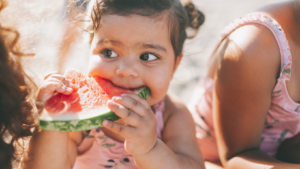
For babies and toddlers under the age of 2:
Added sugars shouldn’t be part of a regular diet. If you would like to serve something sweet, try using naturally occurring sugars like fruit in moderation when baking or cooking.
By avoiding introducing added sugars before two years of age, you’ll get a head start on helping your child develop taste buds and a preference for more nutritious food.
Some tips:
- Role model healthy eating to your child by consuming a variety of nutritious foods.
- If purchasing baby food products, choose brands and products that contain 0g added sugar and aim to cook whole foods whenever possible.
- Allow added sugar in moderation if you desire (smash cake as an example), aiming for 90% nutrient dense food intake and 10% less nutrient dense foods.

For children over age 2:
- Avoid placing special emphasis on foods containing added sugars. They should not be referred to as a “bad” or “less healthy”, and avoid referring to added sugar foods as “treats.” Call a cupcake a cupcake, etc.
- Avoid overly restricting foods containing added sugars. Studies show that restriction of foods leads to obsessing over that food. Limit sweets to 1-2 portions per day if you are providing.
- Allow them to have a choice on what added sugar food they receive so they are exercising their control and independence. You can decide when these foods are available in the house and when they are served.
- Avoid using foods as a “treat” for good behavior. Food bribing like “eat your veggies so you can have dessert” is a no-no.
- Don’t stress if your child over indulges at a birthday party, continue to offer them nutritious foods as the majority of their diet.
Parents and caregivers play a role
Parents and caregivers are responsible for modeling healthy food choices and dietary practices, which shape children’s food preferences and eating behaviors.
Parents should avoid practices that lead to overeating in toddlers (e.g., feeding to soothe or to get children to sleep, providing excessive portions, pushing children to “clean their plates,” punishing with food, force-feeding, allowing frequent snacks or grazing).
In general, parents should use the approach of “the parent provides, the child decides,” in which the parent provides healthy food options, and the child chooses which foods to eat and how much.
Milk & Grow has great post on foods and ways for both adults and children to eat less sugar: 12 Ideas On How To Reduce Sugar Intake For You And Your Child
Artificial Sweeteners and Sugar Alcohols
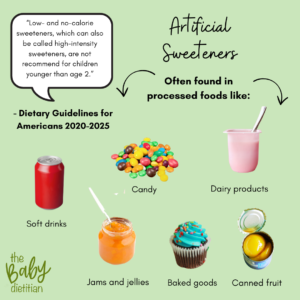
What are artificial sweeteners?
Artificial sweeteners are low-calorie or zero-calorie sweeteners that are also known as high-intensity sweeteners because they taste sweeter than natural sugar. Because they are hundreds to thousands of times sweeter than sugar, only tiny amounts are needed to equal the sweetening power of sugar.
While they’re FDA approved, that doesn’t mean they’re recommended for everyone, particularly infants and toddlers.
There are 8 nonnutritive sweeteners currently approved by the US Food and Drug Administration (FDA). These “high intensity” sweeteners, which are between 180 and 20,000 times sweeter than table sugar.
- Saccharin
- Aspartame
- Acesulfame potassium
- Sucralose
- Neotame
- Stevia
- Luo han guo (extracts of Siraitia grosvenorii Swingle fruit, also called monk fruit)
- Advantame
Stevia:
- Stevia (steviol glycosides) has an established acceptable daily intake (ADI) that regulatory bodies like the FDA, WHO, EFSA and others use to determine safety levels.
- The article notes that there are no reported harmful effects of low-calorie sweeteners in children overall, but major authorities do not recommend regular or long-term use of low-calorie sweetened beverages by kids.
- The American Academy of Pediatrics (AAP) specifically advises against low-calorie sweetened foods/beverages in children under 2 years old, including high-intensity sweeteners like stevia.
Monk Fruit:
- Monk fruit sweeteners are generally considered safe for children and no harmful effects have been reported so far, although detailed research in kids specifically hasn’t been published.
- Like stevia, monk fruit products are classified by regulators as safe when consumed within recommended limits (e.g., ADI for stevia compounds), but the piece highlights that research specifically on use in children is limited.
Key takeaway on kids
Neither stevia nor monk fruit has strong evidence showing harm in children at normal intake levels.
*However, authoritative pediatric guidance (AAP and U.S. Dietary Guidelines) does not recommend use of low-calorie sweeteners, including stevia and monk fruit, in children under 2 years old due to lack of safety data.
What are sugar alcohols?
Sugar alcohols are sometimes referred to as artificial sweeteners, however they are a little different. Sugar alcohols are also a type of sweetener, typically used in foods labeled “sugar-free” or “no sugar added.”
You’ll find them in sugar-free foods such as:
- Candies
- Cookies
- Soft drinks
- Bread
- Baked goods
- Snack bars
- Cereals
- Dairy products and ice cream
- Canned fruit
- Jams and jellies
You’ll also find them in:
- Chewing gum
- Toothpaste
- Mouthwash
Some whole foods do contain naturally occurring sugar alcohols. Berries, cauliflower, and apples contain naturally occurring sugar alcohols and can be provided as they are nutrient dense and a healthy choice for baby. Many store bought products that contain sugar alcohols are highly processed and not particularly nutrient dense compared to whole foods.
The research on artificial sweeteners and sugar alcohols
Can babies have artificial sweetener and sugar alcohols?
Currently, we do not have any data or research on the impact of providing sugar alcohols to children. Due to the lack of evidence and the importance of providing nutrient dense whole foods to children during a critical period of growth and development, most health organizations recommend against the use of sugar alcohols in young children.
Recent research suggests possible links between nonnutritive sweeteners and changes in appetite and taste preferences in children. This, in turn, could affect weight and health.
“In addition, low- and no-calorie sweeteners, which can also be called high-intensity sweeteners, are not recommended for children younger than age 2. Taste preferences are being formed during this time period, and infants and young children may develop preferences for overly sweet foods if introduced to very sweet foods during this timeframe.” – Dietary Guidelines for Americans 2020-2025
Other research is looking into whether these sweeteners cause changes in the gut microbiome ― which is made up of “friendly” bacteria — and may affect blood sugar levels and lead to metabolic syndrome, insulin resistance, and diabetes.
While there is no evidence to indicate occasional use of sugar substitutes would cause harm, we do not know that sugar alcohols may have GI side effects which include diarrhea, gas, and bloating. Please keep these side effects in mind if offering sugar alcohols to your children.
Here’s what parents should know:
- These sweeteners are not recommended for children under 2 due to limited data.
- Early childhood is when taste preferences are formed, exposure to very sweet flavors may increase preference for overly sweet foods later
- Non-nutritive sweeteners still activate sweet-taste receptors, and their long-term effects on appetite, metabolism, and food intake in kids are not well understood
- The amount of artificial sweetener in foods is not required to be listed, making it hard to know actual intake
- Research suggests use in children may be associated with a greater preference for sweet foods
- *Monk fruit and stevia are derived from natural plant-based food sources but fall in the same category due to their high-intensity sweetness and lack of research.
- There may be specific situations where non-nutritive sweeteners are helpful (ex: older children with diabetes or certain medical conditions).
Nutrition is never one-size-fits-all. But for children under 2?
- Both the AAP and Dietary Guidelines for Americans recommend avoiding low- and zero-calorie sweeteners, including stevia and monk fruit, due to lack of safety data.
- Bottom line: just because something is sugar-free doesn’t automatically make it better, especially during critical periods of taste development 🤍

*Additional notes:
- Gaps remain regarding our knowledge of the impact on NNS (nonnutritive sweeteners) use on energy sensing and effects on glycemic control, appetite, and dietary intake for >6 months, and even fewer data exist specifically addressing the pediatric population. Future research should explore novel approaches to assessing the long-term effects of NNS use in children (both type and amount), the effect of age of exposure to NNSs and the development of taste preferences, and the effects of age of exposure to NNSs on the development of diabetes mellitus, obesity, early cardiovascular disease, and the developing brain.
- Funding should be allocated to encourage researchers to conduct high-quality research on the use of NNSs in childhood, focusing on age of exposure and taste preferences, neurodevelopment, and effect on the microbiome and its relevance to obesity, metabolic syndrome, and diabetes.
- It is currently unclear whether there are any long-term health effects from these products on children.
- The AAP is advocating for more research on this subject.
Citations:
Hong J, Whelton H, Douglas G, Kang J. Consumption frequency of added sugars and UK children’s dental caries. Community Dent Oral Epidemiol. 2018 Oct;46(5):457-464. doi: 10.1111/cdoe.12413. Epub 2018 Aug 20. PMID: 30125961.
Paglia L. The sweet danger of added sugars. Eur J Paediatr Dent. 2019 Jun;20(2):89. doi: 10.23804/ejpd.2019.20.02.01. PMID: 31246081.
Wazir M, Verma H, Singh J, Singh P, Passey S. The Battle of Natural Sweeteners: A Comprehensive Guide to Monk Fruit and Stevia. Current Research in Nutrition and Food Science. 2025;13(1):24–45. doi:10.12944/CRNFSJ.13.1.2.
https://pediatrics.aappublications.org/content/144/5/e20192765
https://pmc.ncbi.nlm.nih.gov/articles/PMC12678113
https://pmc.ncbi.nlm.nih.gov/articles/PMC8049500

Cinthia Scott is a Registered Dietitian (RD) and International Board Certified Lactation Consultant (IBCLC) with over 10 years experience in the field of dietetics. Cinthia focuses on ensuring optimal nutrition in the first 1000 days of life to ensure optimal growth and development as well as set the stage for long-term health. Cindy is an author, starting solids expert, and advocate for caregivers receiving evidence based education and support surrounding breastfeeding and starting solids.
Cinthia is co-author of the 101beforeone Starting Solids Book, “101beforeone -baby-led feeding cookbook,” and is the founder and owner of The Baby Dietitian LLC which is her private practice built to provide virtual 1:1 services for caregivers surrounding infant nutrition, toddler nutrition, and breastfeeding support. Cinthia is also the creator of the Starting Solids 101 Program which provides caregivers 1:1 support from a Pediatric Dietitian on how to provide optimal nutrition from the start and create healthy eating habits that will last their whole lifetime. To work with Cinthia, you can access her services here.
Cinthia provides tons of free information for parents on her social media accounts as well.
- Instagram: @The.Baby.Dietitian
- Tiktok: @The.Baby.Dietitian
- Facebook