

Halloween Candy for Babies and Toddlers: A Pediatric Dietitian’s Guide
Halloween is such a fun time of year with little ones! Between the costumes, pumpkin patches, trick-or-treating, and festive snacks, there are so many opportunities to make memories as a family. But when it comes to Halloween candy for babies and toddlers, things can feel a little overwhelming.
What Halloween candy is safe for toddlers? Can a one-year-old have candy? How do you handle all the leftover candy without making sweets feel forbidden?
As a Registered Dietitian (RD), International Board Certified Lactation Consultant (IBCLC), pediatric nutrition expert, and mom of three, I understand both the nutritional recommendations and the realities of parenting during the holidays.
The Dietary Guidelines for Americans recommend avoiding added sugars for children younger than two, and many traditional Halloween candies are choking hazards for young children.
But here’s the good news: Your baby or toddler can absolutely participate in Halloween without needing traditional candy!
Let’s talk about age-appropriate Halloween treats, candy safety, and how to encourage a healthy relationship with sweets as your children grow.
Disclaimer: Some of the products linked in this post may be Amazon affiliate links, which means I may receive a small commission if you purchase through my links at no additional cost to you.
Why Most Halloween Candy Isn’t Safe for Babies and Toddlers
Before we talk about Halloween treats, it’s important to understand why most traditional Halloween candies aren’t appropriate for babies and younger toddlers.
1. Halloween Candy Can Be a Choking Hazard
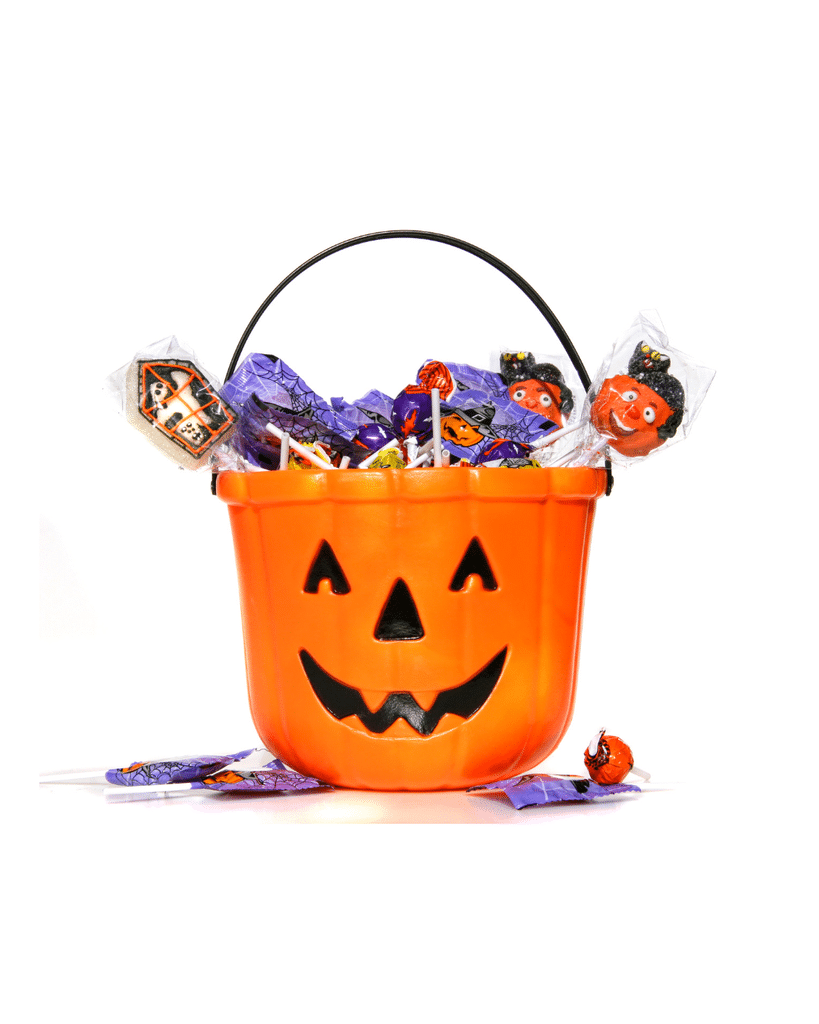
Think about what’s in a typical trick-or-treat bag:
- Candy corn
- Gummy bears and gummy worms
- Hard candies and lollipops
- Caramels and taffy
- Jelly beans
- Peanut M&M’s and other candies containing whole nuts
- Chewy or sticky candy
- Round, hard, or thick candy pieces
Many of these foods are considered choking hazards for children under four, and some continue to pose risks for older children depending on their feeding skills.
Hard, sticky, chewy, and round foods can be especially difficult for younger children to safely chew and swallow.
**As a pediatric dietitian, I recommend avoiding high-risk candies rather than assuming close supervision alone makes them safe.
2. Added Sugar Is Not Recommended Before Age Two
The Dietary Guidelines for Americans recommend avoiding added sugars for children younger than two years old.
During infancy and toddlerhood, children have relatively high nutrient needs but small stomach capacities. We want the majority of their intake to come from nutrient-dense foods that provide important nutrients such as iron, zinc, protein, healthy fats, and fiber.
This doesn’t mean you need to panic if your toddler has a bite of something sweet before their second birthday! It’s about establishing healthy dietary patterns over time, not achieving perfection at every meal or holiday. If you want to learn more about added sugars, read our blog here.
3. Packaged Halloween Snacks Can Be High in Sodium
When choosing packaged snacks for babies and toddlers, I also recommend paying attention to sodium.
For babies under 12 months, the adequate intake for sodium is approximately 110 mg/day from birth through six months and 370 mg/day from seven through 12 months, including sodium naturally present in breast milk or formula.
For children ages one to three, the adequate intake is approximately 800 mg/day, while the chronic disease risk reduction level is 1,200 mg/day.
These are population-level reference values, not strict daily limits for every individual child. Still, choosing lower-sodium packaged snacks when possible can help. Read more about sodium guidelines here.
Halloween Treat Ideas for Babies (6–12 Months)
Just because your baby isn’t ready for traditional Halloween candy doesn’t mean they have to miss out on trick-or-treating!
There are plenty of fun, age-appropriate alternatives that can make Halloween special.
Some of my favorite packaged Halloween snack options for babies include:
- Once Upon a Farm fruit and vegetable pouches
- Little Bellies Softcorn, when developmentally appropriate
- Amara Yogurt Melts, when developmentally appropriate
- Appropriately textured freeze-dried fruit that softens easily
- Little Bellies Pick Me Sticks, for babies with appropriate feeding skills
- Bamba peanut puffs, after appropriate peanut introduction
- Unsweetened applesauce pouches
Important feeding safety reminder: Not every snack on this list is appropriate for every baby starting at six months.
Some foods require more advanced chewing skills or a developed pincer grasp. Freeze-dried fruit, melts, and crunchy snacks vary significantly in texture, and some products may be too hard or difficult to manage safely.
Always assess your baby’s individual feeding skills, check the product’s recommended age and ingredients, and modify the texture when necessary.
Babies should always eat seated upright, with appropriate support, and under direct adult supervision.
And remember, breast milk or infant formula remains the primary source of nutrition throughout the first year. Halloween snacks are simply an opportunity to participate in the festivities, not a nutritional necessity.
Halloween Treat Ideas for Toddlers (12–24 Months)
Toddlers love being included, and having their own Halloween treat bag can be exciting even without traditional candy!
Some fun options include:
- MadeGood mini granola bars, if soft enough for their feeding skills
- Pirate’s Booty
- Little Bellies animal crackers, when age-appropriate
- Garden Veggie Chips, depending on texture and chewing skills
- Once Upon a Farm soft baked bars
- Unsweetened applesauce pouches
- Age-appropriate fruit and vegetable snacks
I also love incorporating non-food treats!
Think Halloween stickers, chunky crayons, stamps, bubbles, or other age-appropriate toys without small detachable parts.
Non-food Halloween treats are especially helpful for families managing food allergies, children with feeding difficulties, or those who simply want alternatives to candy.
Remember: Children younger than three should not receive small toys or objects that could pose choking hazards.
Check out additional non-food items and baby or toddler-friendly treats here!
At What Age Can Babies and Toddlers Have Halloween Candy?
This is one of the most common Halloween questions I receive!
From a nutritional standpoint, the recommendation is to avoid added sugars before age two. However, I also recognize that children are exposed to sweets at different ages, especially when they have older siblings.
In my own household, I don’t go out of my way to introduce candy before my children show interest or begin requesting it.
If your one-year-old is perfectly happy trick-or-treating for applesauce pouches or other fun snacks, there’s no reason to introduce candy just because it’s Halloween.
Once children become interested in candy, though, I believe we have an opportunity to help them learn how sweets fit into an overall balanced diet.
My goal isn’t to make candy forbidden or exciting because it’s restricted. It’s to help my children develop a healthy relationship with all foods.
What Halloween Candy Is Best for a Three-Year-Old?
There isn’t one research-backed answer for the healthiest Halloween candy.
However, when choosing candy for younger children, I focus primarily on choking safety rather than trying to identify the candy with the best nutritional profile.
For children with appropriate chewing skills, small portions of smooth, plain chocolate may be easier to manage than hard, sticky, or chewy candy.
Examples include:
- Plain miniature Hershey’s chocolate bars
- Smooth Reese’s Peanut Butter Cups, for children without a peanut allergy
- Other small pieces of plain chocolate without hard, chewy, or whole-nut inclusions
These aren’t necessarily nutritionally superior candies. They’re simply options that may present fewer choking concerns than many traditional Halloween candies.
I would avoid offering gummies, hard candy, lollipops, whole-nut candies, and sticky caramels to young children.
Also, remember that alternative candy brands aren’t automatically healthier. Products made with organic ingredients or natural sweeteners can still contain similar amounts of added sugar.
And some sugar-free candies contain sugar alcohols that may cause gastrointestinal discomfort.
Bottom line: Candy is candy! Choose options that are developmentally appropriate, account for food allergies, and fit your family’s preferences.
Are Gummy Candies Safe for Toddlers?
Gummy bears, gummy worms, fruit chews, and similar sticky candies are common choking hazards for young children.
Their chewy, sticky texture can make them difficult to break down and swallow safely.
I recommend avoiding these candies for children under four and continuing to use caution with older children depending on their chewing skills.
Supervision is essential, but it does not eliminate the choking risk associated with these foods.
Should You Use the Switch Witch for Halloween Candy?
The Switch Witch is a popular Halloween tradition where children leave their candy out overnight and receive a toy or another surprise in exchange.
I think this approach can be helpful in certain situations, especially for children with food allergies who may receive candy they cannot safely eat, or for families wanting to exchange choking-hazard candies for safer alternatives.
However, I personally haven’t used the Switch Witch as a way to remove all of my children’s Halloween candy.
Here’s why.
I see Halloween as an opportunity for children to practice managing candy intake in a safe, supportive environment.
When we take candy away simply because it’s considered unhealthy, we may unintentionally send the message that candy is bad or forbidden.
Restricting highly desired foods can sometimes increase children’s interest in them, although individual responses vary.
Instead, I prefer to help my children learn that candy can be enjoyed alongside other foods without guilt, shame, or fear.
If the Switch Witch works for your family, that’s okay! I just encourage parents to consider how they explain the tradition and avoid labeling foods as good or bad.
How Do You Keep Kids From Eating Too Much Halloween Candy?
This is probably one of my favorite questions because it opens the door to a bigger conversation about responsive feeding and raising children with a healthy relationship with food.
Two common parental responses to candy are pressuring children to eat certain foods and strictly restricting access to sweets.
Neither approach is ideal when used rigidly.
Research suggests that overly controlling feeding practices can interfere with children’s ability to respond to internal hunger and fullness cues and may increase their interest in restricted foods.
Here are a few strategies I use in our household.
1. Offer Candy Alongside Balanced Meals and Snacks
I encourage parents to continue providing balanced meals that include a combination of carbohydrates, protein, fats, and fiber.
These nutrients help support satiety and sustained energy.
You don’t need to make your child earn candy by finishing vegetables, eating protein, or cleaning their plate.
Instead, candy can occasionally be offered alongside a meal or snack without making it a reward.
2. Allow Some Flexibility Around Halloween Candy
On Halloween night, I allow my children to enjoy age-appropriate candy as part of the festivities.
Depending on the child’s age, feeding skills, and ability to manage sweets, some families may find it helpful to offer a defined opportunity to enjoy candy without micromanaging every bite.
This doesn’t mean children need unrestricted access to candy all day, every day.
The goal is to avoid making candy so scarce or forbidden that it becomes more desirable.
3. Help Children Recognize Hunger and Fullness Cues
Sometimes children eat more candy than they intended.
Rather than shaming them or saying, “I told you that would make your tummy hurt,” we can help them recognize how their bodies feel.
For example:
“How is your tummy feeling?”
“Do you feel comfortable, or do you think you’re getting full?”
These conversations can encourage body awareness without creating fear or guilt around food.
4. Don’t Use Candy as a Reward
I recommend avoiding statements such as:
“If you finish your dinner, you can have candy.”
Or:
“If you’re good today, you can have a piece of chocolate.”
Using candy as a reward can increase its appeal and unintentionally place it on a pedestal above other foods.
Instead, let sweets be something children occasionally enjoy as part of normal eating experiences.
5. Remember the Division of Responsibility
One of my favorite approaches to feeding children comes from the Division of Responsibility in Feeding, developed by Ellyn Satter.
Generally speaking:
Parents decide what, when, and where food is offered.
Children decide whether to eat and how much to eat from what’s offered.
This framework can be helpful when navigating Halloween candy, although candy-specific boundaries may vary depending on your child’s age and needs.
You can provide structure around when candy is available while still allowing children to practice listening to their hunger and fullness cues.
What Should You Do With Leftover Halloween Candy?
After Halloween, we usually keep some of the age-appropriate candy available for a few days.
I may offer a selection alongside meals or snacks and allow my children to choose what they would like.
I’ve found that when candy isn’t treated as something forbidden, the excitement often wears off relatively quickly.
Some children may need more support with this than others, and that’s completely normal.
There is no need to keep Halloween candy available indefinitely, but I encourage parents to avoid turning its removal into a punishment.
The goal is to establish reasonable boundaries while maintaining a positive relationship with food.
How Can I Include My One-Year-Old in Halloween Without Candy?
For a one-year-old who has never had candy, I generally wouldn’t introduce it just for Halloween.
Instead, I would offer fun, developmentally appropriate snacks or non-food alternatives.
A few ideas include:
- Unsweetened fruit pouches
- Age-appropriate puff snacks
- Soft snack bars
- Yogurt pouches
- Stickers or other age-appropriate non-food treats
- Small Halloween books
And remember, babies and young toddlers often enjoy the costumes, decorations, family activities, and excitement of Halloween far more than the candy itself!
Final Thoughts: Enjoy Halloween Without Food Guilt
Halloween should be a fun childhood experience, not a source of stress around food.
As a pediatric Registered Dietitian and IBCLC, I want families to understand the importance of nutrition and feeding safety while also recognizing that one holiday doesn’t define your child’s overall diet or relationship with food.
For babies and younger toddlers, focus on age-appropriate foods, avoiding added sugars when possible, and preventing choking hazards.
For older children, Halloween can be an opportunity to practice moderation, body awareness, and enjoying sweets without guilt.
There is room for both nutritious foods and fun traditions in a balanced approach to feeding.
From our family to yours, happy Halloween and happy feeding!
Want more baby-friendly Halloween ideas? Grab our FREE Halloween Guide for age-appropriate snack ideas, non-food treats, and tips to help your little one safely enjoy the festivities.
Written by Cindy Scott, RD, IBCLC — Registered Dietitian, International Board Certified Lactation Consultant, pediatric nutrition expert, mom of three, and founder of The Baby Dietitian.
References and Additional Resources
- U.S. Department of Agriculture and U.S. Department of Health and Human Services. Dietary Guidelines for Americans, 2020–2025.
- Centers for Disease Control and Prevention. Choking Hazards.
- American Academy of Pediatrics, HealthyChildren.org. Choking Prevention.
- National Academies of Sciences, Engineering, and Medicine. Dietary Reference Intakes for Sodium and Potassium. 2019.
- Satter E. The Satter Division of Responsibility in Feeding.
- Birch LL, Fisher JO, Davison KK. Learning to overeat: Maternal use of restrictive feeding practices promotes girls’ eating in the absence of hunger. American Journal of Clinical Nutrition. 2003;78(2):215–220.
- Rollins BY, Savage JS, Fisher JO, Birch LL. Alternatives to restrictive feeding practices to promote self-regulation in childhood: A developmental perspective. Pediatric Obesity. 2016;11(5):326–332.
Want more? My course is a 100% evidence-based approach to starting solids in a way that encourages a healthy dietary pattern from the start.
Check out the Starting Solids 101 Course now!

Cinthia Scott is a Registered Dietitian (RD) and International Board Certified Lactation Consultant (IBCLC) with over 10 years experience in the field of dietetics. Cinthia focuses on ensuring optimal nutrition in the first 1000 days of life to ensure optimal growth and development as well as set the stage for long-term health. Cindy is an author, starting solids expert, and advocate for caregivers receiving evidence based education and support surrounding breastfeeding and starting solids.
Cinthia is co-author of the 101beforeone Starting Solids Book, “101beforeone -baby-led feeding cookbook,” and is the founder and owner of The Baby Dietitian LLC which is her private practice built to provide virtual 1:1 services for caregivers surrounding infant nutrition, toddler nutrition, and breastfeeding support. Cinthia is also the creator of the Starting Solids 101 Program which provides caregivers 1:1 support from a Pediatric Dietitian on how to provide optimal nutrition from the start and create healthy eating habits that will last their whole lifetime. To work with Cinthia, you can access her services here.
Cinthia provides tons of free information for parents on her social media accounts as well.
- Instagram: @The.Baby.Dietitian
- Tiktok: @The.Baby.Dietitian