


Fourth Month Postpartum Update: Life With a Newborn as a Pediatric Dietitian & IBCLC
As a pediatric dietitian and IBCLC, I love documenting each stage of postpartum life—not only to remember these precious moments with my third baby, but also to provide evidence-based infant feeding and development information for other parents. Every baby develops at their own pace, but I hope these monthly updates offer encouragement and reassurance during your own journey.
Disclaimer: Some of the products linked in this post may be Amazon affiliate links, which means I may receive a small commission if you purchase through my links at no additional cost to you.
Four Months Postpartum: The Month of Big Changes
This month felt like a major turning point.
Clara suddenly seems so much more like a baby than a newborn. She’s more alert, more engaged with the world around her, and incredibly interested in everything happening around her. Watching her personality continue to emerge has been one of my favorite parts of this month.
Four Month Sleep Schedule
One of our biggest changes this month has been sleep.
We somehow skipped the dreaded four-month sleep regression, which I know isn’t the norm for every family, but we definitely noticed some changes in her sleep patterns.
She has started sleeping in longer stretches overnight, although she now tends to wake a little earlier in the morning and occasionally has more alert wake-ups that require a little extra rocking or soothing before she falls back asleep.
During the day, she’s still taking naps approximately every 90–120 minutes, which is completely appropriate for her age. We continue to follow her cues rather than watching the clock, and that approach continues to work really well for our family.
Breastfeeding at Four Months
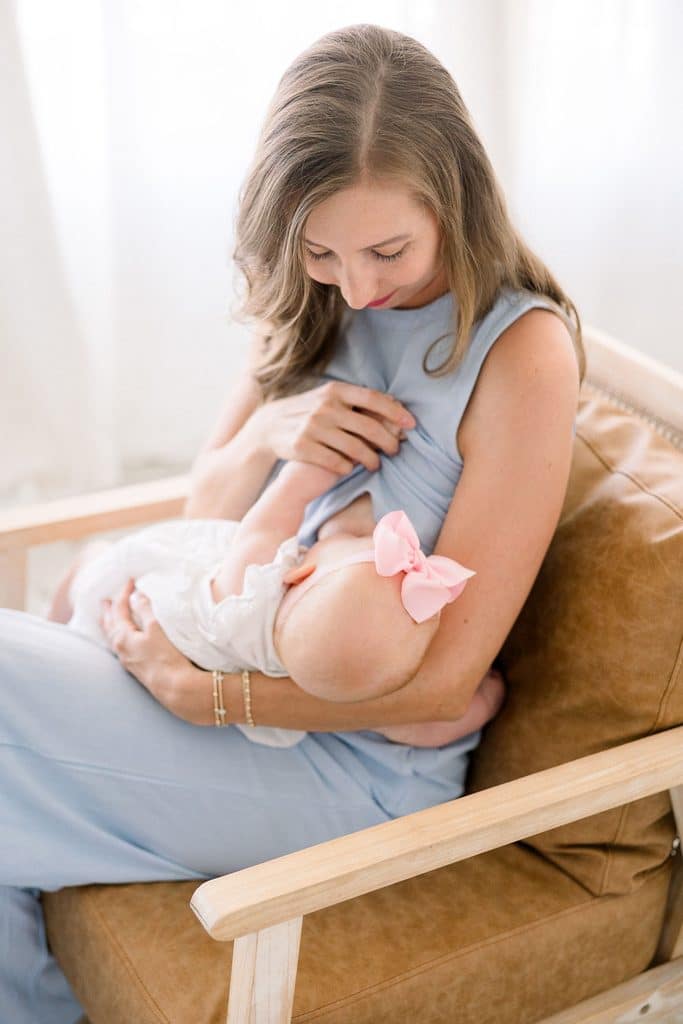
Breastfeeding continues to go wonderfully.
She still nurses approximately every 90–120 minutes throughout the day, which ends up being around 10–12 nursing sessions every 24 hours. This is still absolutely within the range of normal for an exclusively breastfed baby.
One thing I always encourage parents to remember is that feeding frequency alone isn’t the best measure of breastfeeding success. We continue monitoring:
- Her growth curve
- Wet and dirty diapers
- Hunger and fullness cues
- Overall development
Those indicators tell us far more than simply watching the clock.
She’s become an incredibly efficient nurser. Sometimes she wants to feed for just two minutes and have a small snack, while other times she nurses for closer to five-ten minutes. Every feeding looks a little different, and that’s completely normal. Just like we as adults consume a different volume of food every time we eat.
Reminder that:
- Babies appetites fluctuate throughout the day just like our appetite does.
- Some feeds they may take more and some feeds they may take less.
- Babies have tiny stomachs requiring frequent feeds, try to avoid “holding them off.”
- When in doubt, offer a milk-feed.
One question I get all the time is, “Shouldn’t my baby be drinking much more milk by now?” Surprisingly, not necessarily. After the first month or so, the total volume of breast milk babies consume often remains relatively stable, even as they continue to grow. Instead of dramatically increasing in volume, breast milk continues to adapt throughout lactation. Its composition changes over time—including shifts in protein, fat, and other bioactive components—to help meet your baby’s changing nutritional needs. It’s one of the many incredible ways breast milk is uniquely designed for babies. Rather than focusing on ounces consumed, I encourage parents to monitor growth, diaper output, development, and their baby’s hunger and fullness cues.
Sources:
- Kent et al. Pediatrics. 2006.
- Ballard & Morrow. Pediatric Clinics of North America. 2013.
- Andreas et al. Early Human Development. 2015.
- WHO/FAO. Nutrient Requirements and Dietary Guidelines for Infants and Young Children. 2023.
Pacifier Use: Every Baby Is Different
She has officially become my biggest pacifier baby.
Interestingly, I don’t think this is a coincidence. Because she spent time in the NICU, she was introduced to a pacifier very early to help comfort and soothe her while she was receiving medical care away from me.
The decision to use a pacifier should always be individualized for each family and baby, but for her it has clearly become an important source of comfort.
The only downside?
She wants it all…the…time.
Soon we’ll slowly begin working toward weaning from the pacifier, and honestly, I think that may be one of our biggest parenting challenges yet. Wish us luck!
Digestion, Diapers & Overall Health
Thankfully, this month has been incredibly uneventful from a digestive standpoint—which as a pediatric dietitian, I certainly appreciate.
She continues to have:
- Plenty of wet diapers throughout the day
- Approximately 1–4 bowel movements daily
- Minimal spit-up (usually only once every couple of days)
Unlike one of her older brothers, we haven’t had to navigate food sensitivities or maternal elimination diets during breastfeeding, and I feel incredibly grateful for that. If you want to grab our freebie on how to optimize breast milk through your maternal diet, you can grab that here!
Preparing for Starting Solids Before Six Months
One of my favorite changes this month has been watching her curiosity about food.
She is absolutely fascinated whenever we’re eating. She watches every bite, studies our chewing, and clearly wants to understand what’s happening during meals.
While she isn’t ready to begin solids just yet, she has officially started joining us at the table in her high chair during family meals. Check out our full high-chair positioning guide here.
This is actually one of my favorite ways to prepare babies for starting solids.
Even before six months, babies can benefit from:
- Watching parents eat
- Participating in family meals
- Exploring spoons and feeding tools – our favorites are linked here.
- Developing curiosity about food
- Building positive mealtime experiences
If you’d like to learn more, I have an entire blog post here dedicated to preparing babies for solids before six months of age.
Four Month Growth & Pediatrician Update
We recently had her four-month well-child visit, and she continues to grow beautifully.
She had an impressive jump from the 60th percentile to the 93rd percentile for length while remaining around the 50th–60th percentile for weight.
Watching her consistently follow her own growth curve has been incredibly reassuring.
She is now comfortably wearing 3–6 month clothing and somehow seems to be growing overnight.
Developmental Milestones at Four Months
This month brought so many exciting developmental changes.
At her pediatrician appointment, they commented on her impressive head control and core strength.
Currently she can:
- Occasionally tripod sit with support
- Be comfortably carried on our hips
- Roll from tummy to back
- Bring toys to her mouth
- Reach for and grasp objects
- Constantly seek eye contact and interaction
She absolutely loves chewing on everything she can get her hands on.
Some of her favorite toys right now include the EZPZ oral development tools and the EZPZ spoons that we’ll eventually use for self-feeding once we begin solids.
She still seems convinced she’s teething, although those bottom teeth haven’t made their appearance just yet.
She’s becoming much more aware of everything her brothers are doing and desperately wants to join in the fun. Unfortunately, her body hasn’t quite caught up with her curiosity yet.
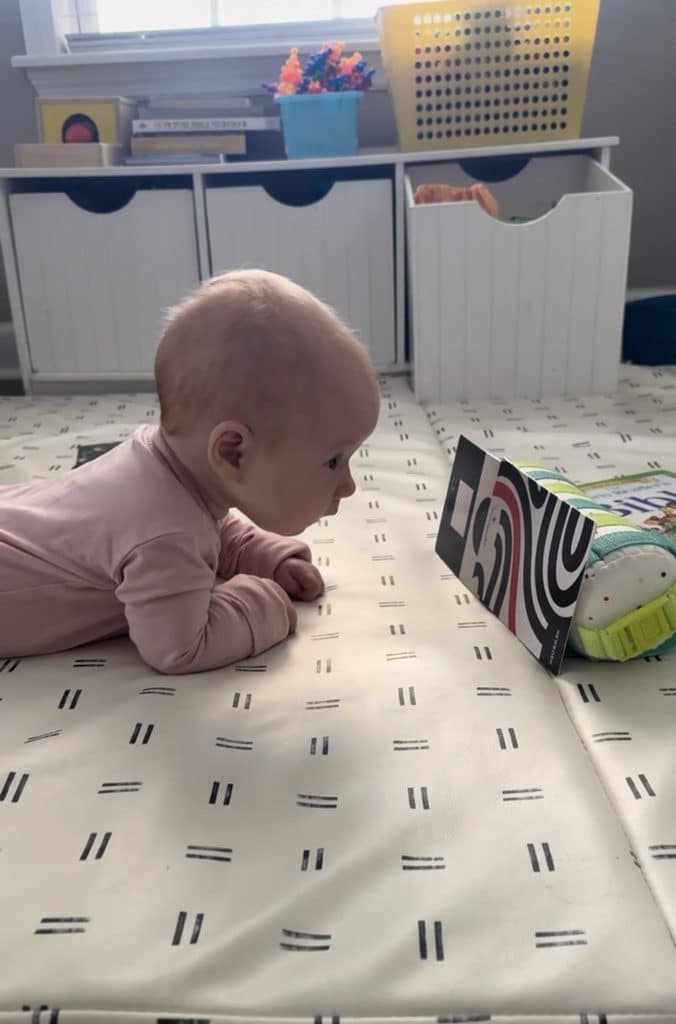
Tummy time still isn’t her favorite activity. She’ll tolerate it for a few minutes before promptly rolling back onto her back. We haven’t quite seen that first back-to-belly roll yet, but I have a feeling it’s coming soon.
Car Seat Wins
I never thought I’d say this…
But we’ve made huge progress with the car seat.
Just a month ago, even short rides felt stressful.
This month we successfully completed a three-hour road trip, and she exceeded every expectation.
Now that she can hold toys, bring them to her mouth, interact with us, and stay entertained for longer stretches, car rides have become so much easier.
She absolutely loves:
- Music
- Dancing
- Eye contact
- Conversation
- Smiling back at anyone who smiles at her
She is probably the smiliest baby we’ve ever had.
Pumping & Milk Storage
At this point, I have approximately 30–40 ounces of breast milk stored in the freezer.
I’ve intentionally stopped trying to build a large freezer stash simply because I don’t have the time.
Between three children, work, and everyday life, finding time to pump and then wash all of the pump parts, can feel overwhelming.
I pump occasionally so Chris can give her a bottle while I catch up on work, but that’s about it these days.
This experience has given me an even deeper appreciation for exclusively pumping moms.
The amount of time, planning, and dedication required is incredible, and they truly deserve so much recognition.
My Favorite Breast Pumps
I’ve had the opportunity to try quite a few breast pumps over the years, and this postpartum my favorites have been:
- BabyBuddha Pump
- Willow Pump
- Elvie Pump
I’m planning to write an in-depth comparison of my favorite (and least favorite) breast pumps soon because I receive questions about this almost daily.
Stay tuned for that post!
Baby Carriers We’re Loving
Babywearing continues to be one of my favorite parenting tools.
We officially graduated from our beloved WildBird newborn carrier, which I absolutely loved during the newborn stage.
Now we’ve transitioned into the Mabe Carrier, and honestly, I may love it just as much.
The fabric is incredibly soft, the support is excellent, and it’s been perfect for keeping up with life alongside two busy older brothers.
I am an affiliate for both baby carriers.
Final Thoughts at Four Months Postpartum
Four months has been such a fun season.
She’s becoming more interactive every day, sleeping longer stretches, laughing, smiling constantly, and showing so much excitement about the world around her.
This postpartum has reminded me not to rush through these stages.
We’re still nursing to sleep. We still rock her before naps. We still soak up every cuddle.
As a third-time mom, I know how quickly this season passes, and this time around, I’m perfectly content letting her be little for as long as she needs.
Want more? My course is a 100% evidence-based approach to starting solids in a way that encourages a healthy dietary pattern from the start.
Check out the Starting Solids 101 Course now!

Cinthia Scott is a Registered Dietitian (RD) and International Board Certified Lactation Consultant (IBCLC) with over 10 years experience in the field of dietetics. Cinthia focuses on ensuring optimal nutrition in the first 1000 days of life to ensure optimal growth and development as well as set the stage for long-term health. Cindy is an author, starting solids expert, and advocate for caregivers receiving evidence based education and support surrounding breastfeeding and starting solids.
Cinthia is co-author of the 101beforeone Starting Solids Book, “101beforeone -baby-led feeding cookbook,” and is the founder and owner of The Baby Dietitian LLC which is her private practice built to provide virtual 1:1 services for caregivers surrounding infant nutrition, toddler nutrition, and breastfeeding support. Cinthia is also the creator of the Starting Solids 101 Program which provides caregivers 1:1 support from a Pediatric Dietitian on how to provide optimal nutrition from the start and create healthy eating habits that will last their whole lifetime. To work with Cinthia, you can access her services here.
Cinthia provides tons of free information for parents on her social media accounts as well.
- Instagram: @The.Baby.Dietitian
- Tiktok: @The.Baby.Dietitian