




First Month Postpartum After NICU: What We Focused on at Home
The first month postpartum with Clara was not what we expected – but in many ways, it became exactly what we needed.
After an unexpected NICU stay where we could only see her during set hours, coming home shifted everything for us. Like many parents navigating the transition from NICU to home, we didn’t want schedules or pressure, we just wanted time with our baby.
So that’s exactly what we did.
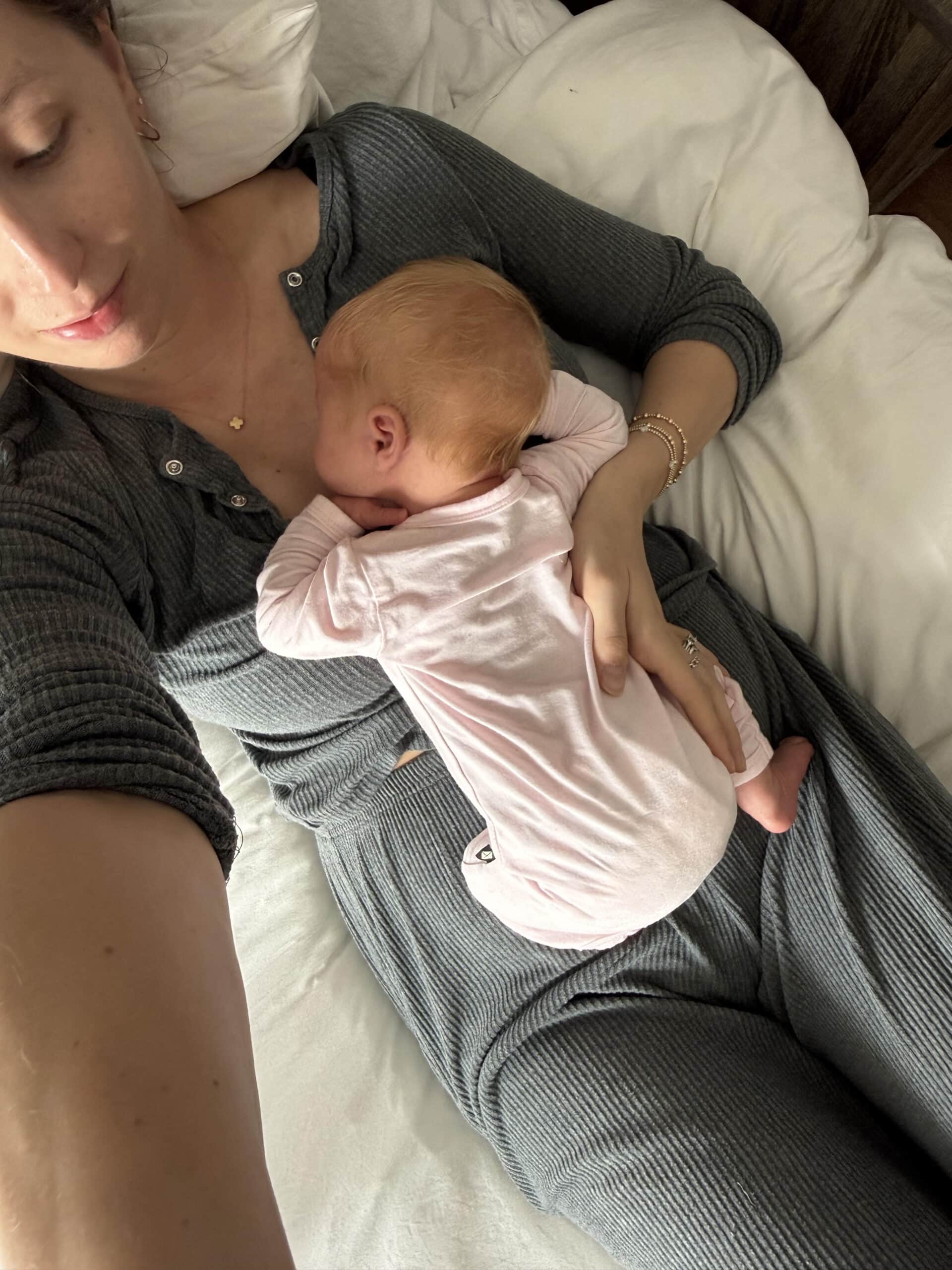
We leaned fully into slow days, contact naps, and following her lead. Clara was (and still is) the sleepiest baby, which made it easy to soak in those early days. After time apart in the hospital, the constant closeness felt like healing.
Adjusting to Life at Home After the NICU
The transition from NICU to home can feel overwhelming. You go from structured care and monitoring to complete independence overnight.
For us, that meant intentionally creating a calm, low-pressure environment. Our newborn essentials blog outlines a lot of the things on hand that made this time period a lot easier for us.
Instead of focusing on routines right away, we focused on:
- Bonding
- Rest
- Rebuilding connection after time apart
Those early days weren’t about doing things “perfectly”- they were about being together.
Letting Go of a Newborn Schedule
One of the biggest decisions we made was to not follow a strict newborn schedule.
No rigid wake windows.
No pressure to optimize sleep.
Just responsiveness.
That looked like:
- Frequent contact naps
- Feeding on demand
- Watching her cues instead of the clock
For families bringing a baby home from the NICU, this flexibility can feel like a big shift, but it can also be incredibly healing.
Breastfeeding After a NICU Stay
Even with a NICU stay, Clara has been my easiest baby to nurse. She came out eager, strong, and ready to latch.
That said, breastfeeding after the NICU isn’t always seamless, and we did face some challenges early on.
Working Through a Shallow Latch
I experienced nipple soreness for the first two weeks, which was most likely due to a shallow latch.
In the NICU, my priority was simple: make sure she was transferring milk.
Once we were home, I shifted my focus to improving latch quality.
What helped:
- Slowing down feeds
- Being more intentional with positioning
- Focusing on achieving a deeper latch
We also used weighted feeds at home to confirm she was transferring milk well, which gave me a lot of reassurance.
Feeding Frequency + What’s Normal
At one month, Clara feeds about 12 times per day, which is completely normal for a breastfed newborn.
Frequent feeding:
- Supports milk supply
- Helps regulate intake
- Meets rapid growth needs
Oversupply + Spit-Up
I also experienced some oversupply early on, which led to:
- Faster milk flow
- Occasional large spit-ups
As my supply regulated, those episodes became much less frequent.
This is a good reminder that early feeding challenges don’t always mean something is wrong; sometimes they just need time to balance out. Laid-back positioning worked really well for me to avoid her “gulping” and taking excess milk too fast.
Newborn Sleep After NICU
Clara has been our easiest sleeper so far.
While newborn sleep naturally includes frequent wake-ups, she did surprisingly well sleeping in her bassinet without needing to be held.
We suspect part of that is due to her NICU stay because she had early exposure to sleeping independently.
We didn’t follow a rigid sleep schedule, but she naturally fell into a rhythm of:
- Sleeping around 9:30 PM to 7:30 AM
- Waking 3–4 times to nurse
In those early weeks, I was intentional about not letting her go longer than 3-4 hours without feeding to support growth and adequate intake.
Balancing Night Feeds and Sleep
To make newborn nights more manageable, my husband would give one bottle per night so I could get a longer stretch of sleep.
Our simple system:
- One overnight bottle feed
- I pump in the morning to replace it
Since milk production is typically highest in the morning, this worked well without negatively impacting supply.
For many families, this can be a helpful way to balance breastfeeding and maternal sleep in the early postpartum period.
Helping Siblings Adjust to a New Baby
The hardest part of this month wasn’t feeding or sleep; it was the emotional transition for our family.
Our older boys had a difficult time with the unexpected 6-day hospital stay. That separation was hard on all of us.
Our 4-year-old especially struggled with jealousy, which showed up as acting out when Clara was getting attention.
We had to be very intentional about:
- Creating one-on-one time with him
- Giving him focused attention
- Helping him feel secure in his new role
We’ve also been processing the NICU experience as a family and I’ve been going to therapy to work through that experience myself.
Postpartum Healing: Slowing Down After Birth
This first month postpartum wasn’t about productivity.
I didn’t focus on:
- Working out
- Eating perfectly
- Losing weight
- Staying on top of to-do lists
We said no to commitments.
We accepted help.
We allowed ourselves to be cared for.
And honestly, it was one of the most healing seasons we’ve had.
Disclaimer: We recognize how much support shaped this season for us. Chris was able to stay home for the first six weeks postpartum, which gave us the space to truly slow down and focus on healing. He handled school drop-offs and pick-ups for the boys and took them on plenty of fun outings while Clara and I stayed home to bond. We were also incredibly supported by our community, who provided many of our meals during those early weeks. Between that and a stash of freezer meals, we rarely had to cook; something that made a meaningful difference in our recovery and ability to be present.
The Reality of the First Month Postpartum
Looking back, I wish more of life looked like that first month:
Slow mornings
Full hearts
Nowhere to be
If you’re in the postpartum season, especially after a NICU stay, know this:
You don’t need a perfect schedule.
You don’t need to do it all.
You’re allowed to slow down and just be with your baby.
Want more? My course is a 100% evidence-based approach to starting solids in a way that encourages a healthy dietary pattern from the start.
Check out the Starting Solids 101 Course now!

Cinthia Scott is a Registered Dietitian (RD) and International Board Certified Lactation Consultant (IBCLC) with over 10 years experience in the field of dietetics. Cinthia focuses on ensuring optimal nutrition in the first 1000 days of life to ensure optimal growth and development as well as set the stage for long-term health. Cindy is an author, starting solids expert, and advocate for caregivers receiving evidence based education and support surrounding breastfeeding and starting solids.
Cinthia is co-author of the 101beforeone Starting Solids Book, “101beforeone -baby-led feeding cookbook,” and is the founder and owner of The Baby Dietitian LLC which is her private practice built to provide virtual 1:1 services for caregivers surrounding infant nutrition, toddler nutrition, and breastfeeding support. Cinthia is also the creator of the Starting Solids 101 Program which provides caregivers 1:1 support from a Pediatric Dietitian on how to provide optimal nutrition from the start and create healthy eating habits that will last their whole lifetime. To work with Cinthia, you can access her services here.
Cinthia provides tons of free information for parents on her social media accounts as well.
- Instagram: @The.Baby.Dietitian
- Tiktok: @The.Baby.Dietitian